
 Grains
 Soils
Soils
Publication date
27 Nov 2025




SUMMER COVER CROPPING AND COMPANION CROPPING (INTERCROPPING) IN THE RIVERINE PLAINS
As part of the Extending results from the Soil CRC Plant Diversity project, Riverine Plains is examining the potential role of summer cover cropping and winter companion cropping to increase diversity, improve soil health and increase drought resilience in the region.
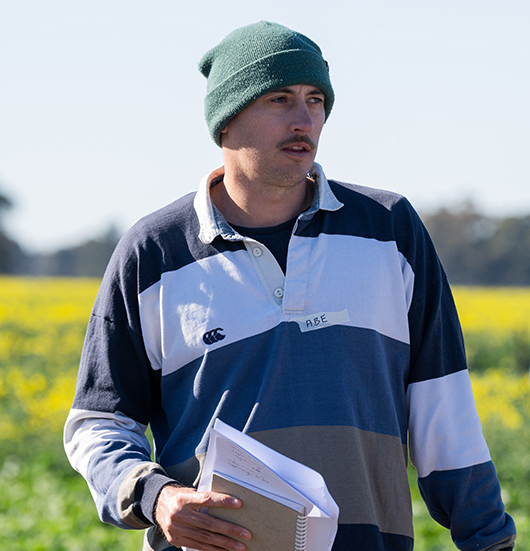
In this Case Study, Southern Cross University Researcher, Abe Gibson shares his insights and experiences of summer cover and winter companion cropping, referencing results from a long-term trial established during 2019 at Burramine, near Yarrawonga in north east Victoria.
Q: How could summer cover crops and companion crops benefit the Riverine Plains?
In the Riverine Plains region, grain farmers typically follow a wheat/canola rotation, with pulses making up a smaller part of the rotation due to their sensitivity to acid soils and inconsistent yields and pricing.
The issue is that monoculture systems—where only one species is sown at a time—tend to have a high export of product from the paddock and this depletes soil organic matter.
Researchers think that increasing the level of diversity in the system can add more biomass and diverse root exudates (secretions) to the soil, helping to promote healthy soil nutrient cycling and a healthy soil ecosystem.
This increased biomass also has potential to increase soil organic matter and soil carbon.
Since 2019, we’ve been running a trial near Yarrawonga, Victoria, as part of Soil CRC projects looking at the role of plant diversity in building soil resilience. We’ve been looking specifically at two options—summer cover cropping and companion cropping—for their potential to build plant diversity and contribute to drought resilience in the longer term.
Q: Briefly, can you describe summer cover cropping and companion cropping?
Summer cover crops are grown over the summer fallow period and aim to provide a living ground cover for soils, compared to retained stubble. They can provide protection from wind and water erosion, increase infiltration rates and provide a potential source of nitrogen and root material. They're different to summer crops grown for grain (eg. maize).
Companion cropping uses winter rainfall to grow more biomass during the season and involves sowing two (or more) crops together at the same time. Wheat and vetch are commonly used because farmers can obtain the nitrogen fixation and diversity benefits from the vetch, while also being able to carry the wheat through to harvest.
In our trial we’ve been looking at two different types of companion cropping; temporary and synchronous companion cropping.
Temporary companion cropping involves sowing more than one species at the same time, then terminating one species and carrying the other through to harvest. Temporary companion cropping wheat and vetch offers an easier way to introduce diversity to systems because farmers don't have to harvest two species at once, or separate seed.
Synchronous companion cropping involves sowing and harvesting two or more species together. In this project, we're looking at faba bean and canola sown together (beanola) and field pea and canola sown together (peaola). In this system, both crops are taken through to harvest, with the different seeds separated using a grader after harvest.
Q: Which crops have you compared?
So far, we've had six years of summer cover crops, and since 2023, our summer cover crop treatments have included:- Low diversity, three species summer cover crop mix of sunflower, millet and cowpea
- High diversity, nine species mix of sunflower, safflower, sorghum, millet, cowpea, buckwheat, radish, turnip and sunnhemp
- Fallow
We've also had three years of temporary companion cropping, with clover/wheat and two years of vetch/wheat. In 2024, we had synchronous companion cropping with beanola and peaola.
Q: Broadly, what are you looking for?
Overall, we're seeing if we can promote yields by increasing diversity within a system, or, whether summer cover or companion crops negatively impact the main winter crop yield by using up soil water, soil mineral nitrogen, or competing for other resources.
We're also interested in the soil health impacts —so looking at things like soil carbon cycling, soil nitrogen cycling, soil respiration and microbial activity—to see how these impact the bottom line, and if they can be used to demonstrate sustainability credentials.
Q: Do you think summer cover cropping has a place in the Riverine Plains?
Since 2019, we’ve observed some benefits but also some drawbacks to summer cover cropping.
Having living ground cover over the summer fallow period is a nice idea, and where we've had years of 1.5–3 t/ha of biomass, we've seen some soil health improvements. When you can generate that level of biomass over the summer, it also provides options for livestock grazing or hay, if that suits your system.
However, we've also seen that establishing this biomass can be quite difficult. And while we've had a couple of good years, we've also had some ordinary ones where we've only had 200–300 kg/ha biomass. This is because over our summer periods, rainfall usually occurs during intense storm events, followed by long, dry, periods of high evaporative demand, drawing up soil moisture and making it hard for summer cover crops to grow.
Compared to stubble retention, having a living ground cover can provide benefits to soil, when that high biomass can be produced. But, in dry years, seed and starter fertiliser costs are sunk costs, and are a potential loss for the farmer.
Q: What does summer cover cropping do to soil moisture ahead of the next winter crop?
Summer cover crops can definitely deplete soil water available for the next winter crop.
While we haven't seen statistically significant individual impacts on soil moisture or soil nitrogen on a year-to-year basis, there's been a general trend to depleting the amount of soil water and mineral nitrogen available at sowing with increasing summer cover crop biomass. This can lead to a 1–3 percent, decrease in the main winter crop yield, sometimes even as high as 10 percent in high biomass production years.
As such, farmers need to consider the trade-off between the benefits of having a living ground cover over summer, and the next winter crop yield.
Q: How do livestock fit in with summer cover cropping?
Although we haven't looked specifically at any grazing benefits, or integration of livestock in this trial, having a living cover provides an opportunity to produce better quality feed and maintain livestock condition over that summer fallow period, when you can generate that biomass.
Q: Does companion cropping have a fit in the Riverine Plains?
In our temporary companion cropping treatments, where we've sprayed out the vetch and taken the wheat to harvest, we've generally seen a slight suppression of wheat biomass when the vetch was terminated after 6–8 weeks of growth, compared to the wheat-only treatment. However, favourable conditions over the last few years meant wheat biomass has tended to catch up by flowering.
Overall, we've seen up to 1 t/ha vetch biomass produced, which is considered additional biomass on top of the wheat biomass we've produced. Although we've produced this additional biomass, we still haven't quite seen any changes to soil organic matter and soil organic matter cycling as a result of that.
Beanola and peaola were included for the first time in 2024 as part of the synchronous companion cropping trial. The 2024 season was very favourable for faba bean growth, with the beanola treatment yielding higher per unit of land area than canola or faba bean sown on their own. However, in 2024 the site also experienced a late frost, which impacted field pea yields. This resulted in the peaola combination giving higher yields per unit of land area compared to the field pea monoculture.
In terms of synchronous companion cropping with beanola and peaola, there's potential to increase the yield per unit of land area, which can then improve gross margins compared to growing a monoculture of the same crop. If farmers can partner those yield improvements with improvements in their margins, along with improvements to soil health, that has potential for being more resilient to climate extremes and operating more sustainably in the long term.
Q: Financially, which systems performed the best?
For the synchronous companion cropping system in 2024, a one-year analysis showed the gross margins on the beanola was nearly double that of canola and considerably more than faba beans grown on their own.
We had a really good year for faba beans in 2024, due to high yields and good pricing, and their return was also a lot higher than the monoculture canola.
Our field peas suffered from frost, so they actually represented a loss for us from an operating point of view. Peaola returned a gross margin slightly higher than canola alone.
We also conducted a two-season rotational gross margin for all treatments from 2023–2024. A key message was that poor summer cover crop establishment was a risk, with only two good summer crops in six years due to unreliable rainfall. The more expensive the summer cover crop establishment cost (seed, fertiliser, weed control etc), the greater the negative economic impact of poor growth.
The analysis did not show a significant enough difference between all the other options to confidently choose summer cover crops based on the results of this trial. Further analysis, including nutrient availability and water storage, may alter these results.
Q: Were there any soil water changes from cover or companion cropping? Could this improve drought resilience?
After a high-rainfall summer which generated 2–3 t/ha of summer cover crop biomass, we found an increase in soil infiltration. The theory is that the summer cover crop, as a living ground cover, creates lots of roots under high biomass conditions, which in turn can lead to better soil aggregation. This aggregation can improve infiltration, while the root channels also provide more pathways for water to infiltrate the soil.
While we only saw this in one year of the trial, we're looking to investigate the principles and processes that could lead to better infiltration. If we can achieve higher infiltration through higher plant diversity, this offers potential to buffer farming systems against drought by capturing more water and allowing it to be stored at depth.
In the future, we'll also be looking more closely at aggregate stability and any increases in soil organic nitrogen, which is important for getting soil particles to stick together and form aggregates.
We’ll also be looking at whether the addition of organic matter results in any changes to water holding capacity. From this, we're hoping to see possible outcomes for building soil health. This is a slow process because it's an incremental addition of biomass year-by-year. We're heading into our seventh year in 2026—and it's between here and potentially the tenth year that we really think that the soil health results are going to come through.
Q: What are the key messages for farmers about summer cover cropping and companion cropping in the Riverine Plains?
The trials so far tell us that while summer cover cropping can provide benefits by being a living cover through that summer fallow, it's an opportunistic practice that is only really leveraged when summers are going to be wet and you can guarantee that that biomass is going to be generated.
On the other hand, our in-crop companion cropping options, whether temporary or synchronous, are showing real promise because they suit our winter dominant rainfall patterns, which are more reliable.
Our companion crop treatments have provided additional biomass, and in the case of the case of synchronous companion cropping with beanola and peaola, they've provided additional yields and better gross margins. Temporary companion cropping with wheat and vetch (terminated 6-12 weeks after sowing) also hasn't shown any yield suppression of wheat as a result of competition mechanisms. It also offers nitrogen fixation benefits and the potential for diversity to build soil health.
Acknowledgements
This Case Study was produced as part of the Extending results from the Soil CRC Plant Diversity project. This project of the Regional Drought Resilience Planning program is supported through funding from the Australian Government’s Future Drought Fund and the Victorian Government.
Thanks to Abe Gibson, Southern Cross University, and Eric Nankivell, Farmanco, for their contributions. This article features outcomes from the Building soil resilience and carbon through plant diversity and Increasing Plant Diversity projects, funded by the Soil CRC. The Increasing Plant Diversity project was supported by the Goulburn Broken CMA through funding from the Australian Government’s National Landcare program.