
 Livestock
 Drought
Publication date
12 Mar 2026
This Case Study was produced as part of a Victoria Drought Resilience Adoption and Innovation Hub project, through funding from the Australian Government's Future Drought Fund.
Riverine Plains is the North East Node Lead for the Victoria Drought Resilience Adoption and Innovation Hub.



INSIGHTS INTO SHEEP STOCK CONTAINMENT AREAS
Stock containment areas are valuable livestock management tools that can increase drought resilience, protect soils and improve efficiency and productivity.
As part of the Victoria Drought Resilience Adoption and Innovation Hub, delivered through funding from the Australian Government’s Future Drought Fund, Riverine Plains has been working with farmers in north east Victoria to raise awareness of stock containment areas.
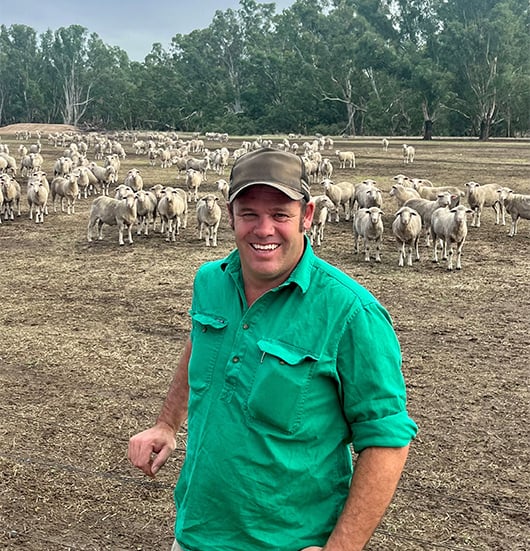
In this article, Don Piper — a mixed sheep and crop farmer from Earlston near Violet Town — shares his experiences of using stock containment areas, including their benefits and design.
A case study with Don Piper
For Don Piper, stock containment areas have become an important tool for managing soil health and enhancing productivity.
Joining approximately 3400 ewes annually, their self-replacing Merino and composite sheep flocks are the main part of the family's farming operation. The Merinos comprise 60 percent of the total flock, with the composites making up the other 40 percent on the 1420 ha farm.
Through targeted genetic selection, Don is developing a more “dual-purpose” Merino flock, with improved do-ability and meat yield.
The ewes are joined in late January to lamb in June and July, aligning stock feed demands with feed supply curves. Broadacre cereals are also grown, mainly for livestock feed on-farm.
Improving performance
Don is passionate about continuously improving the performance and sustainability of his livestock, pastures, crops and soil.
This has led Don to expand and improve his existing containment area, so that it now has the capacity to hold over half his flock at a time.
“The main reason behind the move was to achieve our minimum ground cover target of 90 percent to address our soil health concerns.
"By achieving this, we've found the country responds very quickly to autumn breaks, and does more on less rain than bare paddocks.
“Secondly, it allows us to carry more breeding ewes without turning the paddocks to dust”.
It's recommended that pastures be kept at a minimum 70 percent ground cover to prevent erosion — when this threshold is reached, stock should be moved to a paddock with greater ground cover, or to a stock containment area.
Don places a high value on having an area to hold stock, as it provides pastures the opportunity to recover between grazings, following rain, or during a dry period.
“It also allows us to build a feed wedge before ewes are reintroduced to the paddocks,” he said.
Containment area design
Before beginning, Don did a lot of research and consultation to ensure the purpose-built yards — which are set up for multiple uses beyond drought feeding — would meet their needs.
A major challenge was deciding on the most suitable size and number of stock for the containment feeding pens.
"Despite information suggesting small areas are best, we went with larger to provide more room for exercise," Don explained.
"Our pens are 100 x 50 m, with separate feeding pens of 25 x 100 m, which is a different design to a lot of pens. This allows us to put out feed trails without the risk of running over sheep, and we've found it reduces wastage as the animals tend to spread out quickly across the feed trail, rather than running along chasing and trampling feed.
"In a feedlot situation it also means we can use the feedout pens as feedlot pens, and have smaller lots of lambs in some pens and bigger lots in others, allowing for more weight groups.
A stocking density of 5 m2/sheep or lamb is recommended to reduce dust and decrease infrastructure costs per head.
"We tend to put a maximum 800–850 crossbreed or composite ewes and a maximum of 700–750 merinos in these pens. While we have pushed it to 950, we noticed a higher percentage of shy feeders in comparison to having lower numbers."
More information on stocking densities and stock containment areas can be found at Stock containment areas | NSW Government.
Access to laneways & yards
A laneway connects the stock containment area to nearby yards and paddocks, with Don finding the laneways valuable for allowing ewes to ‘stretch their legs’ while in containment.
“On a weekly basis the sheep roam a laneway for a day, which helps them remain active, and we've found this helps a lot with ease of lambing later on,” he said.
Site design & learnings
The site was built around established gum trees that provide shade for a large proportion of the pens. Water is sourced from a nearby rainfed dam, reticulated to troughs within each pen.
In March 2023, Don hosted a Riverine Plains Demonstration Day, featuring discussions on stock containment area design, use and benefits.
“The day prompted you to really consider important aspects including location, slope, shade, and proximity to water and yards,” he said.
Don also says that simple things like planning where excess water will go in the pens, and keeping feed and water at separate ends, can help avoid pens becoming bogged.
Feeding
Don uses a feed mixer pulled behind a tractor to supply feed into troughs in each pen.
When feeding, a key learning was to be able to draft shy feeders into a separate pen and not to mix different sheep breeds within pens.
“At first, when we didn't have enough pens, I boxed some Merinos and composites together and the Merino’s were bullied,” he said.
Don also recommends using a ruminant nutritionist to help tailor the feed mix, using feedtests from the feed you have available.
Not a one size fits all
A stock containment area needs to be tailored to each operation, which means they often vary greatly between farms. Each aspect of the design, location, materials, feed and water systems should be considered within the landscape, livestock class and overall operation — which also means they require detailed planning.
“When first starting out, I’d encourage people to go look at some pens people have made and used,” Don recommends.
Multiple uses
Stock containment areas can serve multiple purposes beyond drought management.
Given the nearness of Don’s stock containment area to his yards, the area also serves as valuable holding pens for stock prior to entering the yards.
This reduces stress on the animals and increases handling efficiency, allowing Don to check his stock more often, which helps with timely management.
“We get them in quite regularly to do condition scoring, and this allows for much more even lines of ewes. I’m also sure this equates to higher conception rates and more foetuses carried through,” he added.
As with any on-farm innovation, there are always opportunities to improve and Don is looking into automatic feeders to see if they can improve feeding efficiency and reduce the time required.
Acknowledgements
This Case Study was produced as part of a Victoria Drought Resilience Adoption and Innovaton Hub project, through funding from the Australian Government's Future Drought Fund.
Riverine Plains is the North East Node Lead for the Victoria Drought Resilience Adoption and Innovaton Hub. We sincerely thank Don Piper for sharing his experiences and insights.