
 Grains
 Soils
Soils
Publication date
01 Dec 2025




INSIGHTS INTO SUMMER COVER AND COMPANION CROPPING IN THE RIVERINE PLAINS
Extending results from the Soil CRC plant diversity project
Improving soil health is an important part of building resilience to drought and future climate challenges. Summer cover cropping and companion cropping are two methods being investigated for their potential to build diversity and improve soil health in the Riverine Plains.
This article explores key benefits and challenges of these systems, based on outcomes from a long-term Soil CRC and Australian Government's Future Drought Fund trial at Burramine.
Key messages:
- Summer cover cropping is opportunistic in the Riverine Plains given unreliable summer rains
- Summer cover cropping is associated with an emerging trend for declined water availability at the time of winter crop sowing, as well as yield penalties
- Total biomass can be increased by sowing companion crops together, although we haven’t been able to show this to be statistically significant year-on-year at Burramine
- To date, temporary companion cropping wheat with sub clover or vetch has not significantly reduced wheat yield, highlighting its potential to increase diversity in cropping systems
- While temporary companion cropping showed a small additional biomass gain, there has been little-to-no impact on soil health or carbon to date
- In 2024, a beanola companion crop had a gross margin double that of canola and considerably more than faba beans, due to high yields and good pricing
Summer cover and companion cropping definitions
Cover cropping involves planting a living ground cover to protect the soil from erosion and increase the amount of plant matter (biomass) returned to the soil. In southern Australia, cover crops are most often grown over summer to protect soils from wind and water erosion.
Companion cropping (intercropping) involves sowing two or more species at the same time, with the aim of harvesting at least one crop. Often, a legume is planted alongside a cereal or oilseed for the nitrogen and diversity benefit.
Companion cropping usually involves a second species sown to help the main crop succeed, while intercropping targets both species as the main crop. In this article, companion cropping is used interchangeably with intercropping, for consistency across our different projects.
Background: Australia vs overseas
Since 2019, we've been looking at summer and companion cropping for their local fit, impact on soil resilience, carbon dynamics and productivity at a long-term site at Burramine in north east Victoria.
Cover cropping is popular in the northern hemisphere, especially North America, for its role in protecting bare soils from erosion during autumn and winter, as well as water and nutrient run-off in summer (corn and soybean) systems. Companion/intercropping is also practiced for its nitrogen fixation and production benefits.
In the northern hemisphere, both cover cropping and companion cropping have been shown to build soil carbon and fertility with minimal impacts on yields. However, the water and climate dynamics of Northern Hemisphere systems are very different to the hot, dry summers and winter-dominant rainfall that drives cropping in the Riverine Plains.
Our combination of soil types, along with our temperature and rainfall patterns, mean that farmers typically use a dryland winter cereal–canola or cereal–canola–legume rotation. Stubble retention is also widely practiced in the Riverine Plains to protect soil from erosion, reduce evaporation and slow water movement over the summer fallow, similar to the way northern hemisphere cover crops protect the soil. These factors, and additional labour and resources requirements, mean these systems haven't been widely adopted in south eastern Australia.
Benefits of diversity
A key issue in the Riverine Plains is that monoculture crops — single species crops — tend to have a high export of product from the paddock. This depletes soil organic matter, which can impact soil health and productivity.
Researchers think that increasing the level of diversity in the system can add more biomass and root exudates (secretions) to the soil, helping to promote healthy soil nutrient cycling and a healthy soil ecosystem. Increasing biomass also has potential to increase soil organic matter and soil carbon, contributing to increased soil resilience and productivity.
Summer cover cropping
Rainfall & termination
In the Riverine Plains, summer rainfall is sporadic, with storms often bringing intense rainfall, followed by long, dry periods. This makes it hard for summer cover crops to establish and grow.
This was highlighted at Burramine where only two summer cover crops in six years produced more than 1 t DM/ha biomass. The largest biomass (~ 3 t DM/ha) occurred in the summer of 2020/21, while the least (0 t DM/ha) was produced in 2022/23, due to lack of establishing rainfall. Not only is successful biomass production subject to timely rain events, maintaining summer cover crop biomass production through multiple days of > 40°C is also a challenge.
If follow-up rainfall post-sowing is poor, the seed and fertiliser investment will likely be lost. Delays to establishing rainfall (i.e late January or early February) mean that biomass production will likely be reduced.
Summer cover crops are usually chemically terminated in March or early April, after 8–12 weeks of growth. This prevents seed set and conserves moisture and nutrients ahead of winter crop sowing, to maximise yield.
Effect on water, nitrogen & soil function
Summer cover cropping can reduce soil moisture ahead of winter crop sowing. Although our trials haven't shown statistically significant individual impacts on soil moisture or soil nitrogen on a year-to-year basis, there's been a general trend to depleting soil water and mineral nitrogen at sowing with increasing summer cover crop biomass. In high summer cover crop biomass years, the reduction in winter crop yield will depend on the size of the summer cover crop, and whether rainfall replenishes the soil profile.
Since 2019, our summer cover cropping trials have not measurably increased the level of mineralised soil nitrogen, likely due to low levels of biomass and nitrogen fixation. Further, soil health measures related to carbon cycling have not shown significant treatment differences due to summer cover cropping.
A key message is to consider the trade-off between the benefits of a living ground cover over summer and the next winter crop yield.
Infiltration
Summer cover crops have different rooting structures and patterns to traditional winter crops and we saw an increase in saturated hydraulic conductivity following the 2021/22 high biomass summer cover crop treatments. This may be due to improved soil aggregation — soil particles joining together, creating pore space for water and air to move through — due to root growth and exudates.
Higher infiltration offers potential to buffer farming systems against drought by capturing more water and storing it at depth, however, this single-year result needs to be revisited to determine key drivers and if the effect persists.
Pests & disease, weeds
Summer cover cropping can creates a green bridge, increasing pest and disease pressure in the next winter crop. It can also complicate weed control, leading to weed and volunteer issues in later years, as seen at the Burramine trial site.
Livestock
Although we haven't looked specifically at grazing benefits, or integration of livestock in this trial, having a living cover provides an opportunity to create areturn from livestock feed or hay, if that biomass can be generated.
Companion cropping
Companion cropping — sowing two crops at once — offers another way to increase diversity and improve soil health. Legumes are a logical choice for companion cropping alongside cereals or canola because they can contribute up to 20 kg N/ha to the soil per tonne of dry matter (biomass) produced, as well as pest, disease and weed break benefits.
Temporary companion cropping
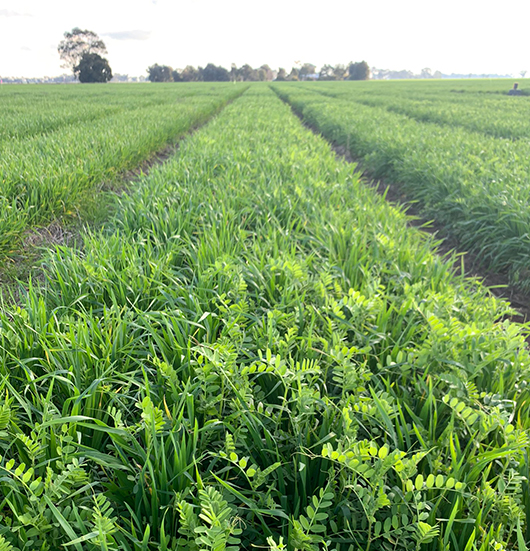
Temporary companion cropping involves sowing two or more species together before one species is terminated. This allows the other species to reach maturity with less competion for resources.
For example, temporary companion cropping vetch with wheat provides an option for livestock systems; the vetch's early growth fills the early feed gap and the vetch can be terminated later in the season to protect wheat grain yield.
Temporary companion systems offer flexibility to respond to seasonal and market conditions. In the wheat/vetch example, the vetch can be kept in the mix for hay or grazing, or terminated if the season is better suited to wheat production.
Biomass & yield
Biomass production is key to increasing the amount of organic matter returned to the soil. Further, the more biomass produced by a legume companion crop, the greater the potential for nitrogen fixation and mineralisation. Farmers can maximise biomass production by sowing companion crops within their ideal window, while appropriate seeding rates will also prevent one species outcompeting the other.
Overall, we've seen up to 1 t DM/ha vetch produced as part of a temporary companion system; this is additional biomass on top of the wheat biomass. Although we found that total biomass can be increased by sowing companion crops together, we haven’t been able to show this to be statistically significant year-on-year.
To date, our trials have not shown that temporary companion cropping wheat with a legume, such as vetch or sub clover, leads to a significantly lower yield of wheat at harvest.
This suggests that companion cropping wheat and vetch (or sub clover) could be a low-risk way to introduce legumes to local systems. The past few seasons have been good for winter crop growth and different results may be seen in drier years with greater resource competition.
Nitrogen & soil health
So far, our results have been inconclusive for nitrogen availability following a temporary legume companion crop. Although soil nitrogen was slightly higher in 2020 (the year after wheat and sub clover), the results were not significant, with results from 2024 still pending. Low biomass production by the temporary legume crop, combined with time required to break down residues, likely explains this response.
Despite producing additional biomass through temporary companion cropping, we have not observed any changes to soil organic matter and soil organic matter cycling.
Synchronous companion crops: two crops at once
While pulses are grown in the Riverine Plains, soil acidity and drainage limits the area sown. Yield and price volatility also means that pulses are often seen as a higher-risk option, despite their benefits. Another way to incorporate pulses is to sow and harvest two crops at the same time, known as synchronous companion cropping.
In our trials, pairing oilseeds and pulses, such canola and field peas (peaola) or canola and faba beans (beanola) has shown potential to increase soil health benefits. Other combinations, such as faba beans with wheat or barley and canola, can also be considered, though the latter won't contribute to soil nitrogen.
Two species logistics
When choosing species for temporary companion cropping, aim for similar maturities, to prevent shattering losses and aid harvest logistics. Seed will also need to be separated post-harvest using a seed grader, with storage and handling another consideration. Sowing and harvesting equipment will need to be configured to manage the different seed sizes.
Pulses will also require inoculation with the appropriate rhizobia to be able to fix nitrogen, unless suitable levels exist in the paddock.
Using cereals or canola in a companion crop mix can help trellis crops like vetch or field peas, lifting pods above the ground for harvest efficiency. Sowing rates should ensure the weight of the climbing plant is adequately supported.
Weedy paddocks should be avoided, due to limited in-crop weed control options.
Biomass and grain yield
We first looked at peaola at Burramine in 2020, seeing a combined canola + field pea yield of 1.9–2 t/ha, which was higher than canola alone, but lower than canola after field pea brown manure (2019).
In 2024, peaola and beanola were again compared to canola, with the average canola-only yield 1.9 t/ha, while the peaola yielded 1.8 t/ha canola and 0.6t/ha field peas, and the beanola yielding 2.2 t/ha canola and 1.3 t/ha faba beans. When biomass or grain yield for a synchronous companion crop species is more than 50 percent of its monoculture, the system is overyielding. In 2024, the canola/faba bean system outperformed the monocultures, noting that 2024 was especially favourable for both faba bean and canola growth, with excellent pricing.
This shows the potential for companion cropping to yield more per unit area than the monoculture (and legacy effects of brown manuring legumes).
Nitrogen & soil health
At Burramine, mean soil carbon levels have varied between 1.1–1.5 percent, which is fairly typical of cropping soils in the region, while soil nitrogen has varied between 0.1–0.15 percent.
Since 2019, there have been no significant treatment differences in soil health measures related to carbon cycling or nitrogen in this trial.
Economics of cover and companion cropping
A simple economic analysis was completed for the Burramine site, using 2023–2024 data.
Key observations from 2024 were that a beanola crop had the highest gross margin at $1444/ha. This was double canola and considerably more than faba beans due to high yields and good pricing. Field peas were affected by frost in 2024 and were uneconomic when grown on their own, while peaola returned a gross margin slightly higher than canola alone.
A two-season rotational gross margin (2023–24) showed that while the analysis term isn’t long enough to draw firm conclusions, poor summer cover crop establishment was a risk, with only two good crops in six years due to poor rainfall. Also, the more expensive the summer cover crop establishment (seed, fertiliser, etc.), the greater the economic impact of poor growth. The economic difference between all other options was not significant enough to confidently choose summer cover crops based on results in this trial. Further analysis will include nutrient availability and water storage, and this may alter the results.
Summary
Improving soil health and carbon requires a sustained increase in plant biomass production over multiple seasons.
Establishing summer cover crops is difficult so their impact on soil health has been limited at the Burramine trial. While summer cover cropping is emerging as an opportunistic practice, farmers require further data to make informed decisions about the likelihood of success each season.
Temporary intercropping has not been shown to reduce yield of the main winter crop in this trial, supporting results from other studies. While temporary intercropping showed a small additional biomass gain in this trial, this has not impacted soil health or carbon.
Synchronous intercrops could have a role to play in building soil health by promoting more biomass production per unit of land area, while also providing plant-to-soil input diversity.
Acknowledgements
Extending results from the Soil CRC Plant Diversity is a project of the Regional Drought Resilience Planning program, supported through funding from the Australian Government’s Future Drought Fund and the Victorian Government. Thanks to Eric Nankivell, Farmanco, for the economic analysis and to Abe Gibson, Southern Cross University for his technical insights.
This article features outcomes from the Building soil resilience and carbon through plant diversity and Increasing plant diversity projects, funded by the Soil CRC and led by Southern Cross University. Increasing plant diversity was supported by the Goulburn Broken Catchment Management Authority through funding from the Australian Government’s National Landcare program.