
 Grains
 Soils
Soils
Publication date
27 Nov 2025




WHEAT AND VETCH AS A COMPANION CROP
The Extending results from the Soil CRC Plant Diversity project is looking at the benefits and challenges of using cover and companion cropping to increase diversity and improve soil health in the Riverine Plains.
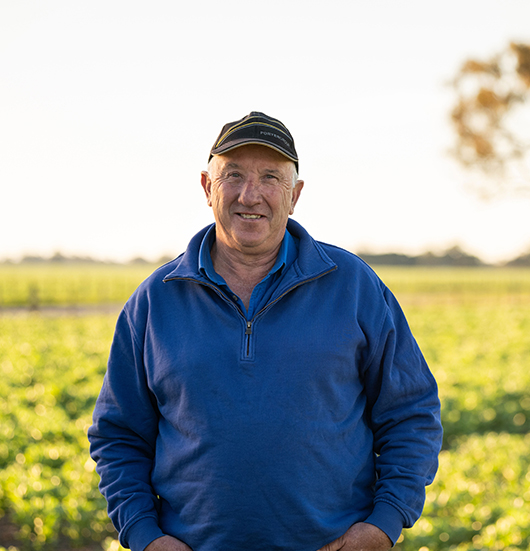
As part of this project, we spoke with Waggarandall farmer, Tony Ludeman, about his experiences of companion cropping wheat and vetch, including vetch termination and brown manuring. Here's what he had to say:
Q: Tell us a little about your farming system
We crop about 2400 hectares at Waggarandall, near Dookie, in north east Victoria.
Our soil types vary quite considerably from nice rising red country, down onto some high pH black soils, to a light loam then into some heavy clays. Our normal annual rainfall is about 525 mm.
We're trying to get into a three-year rotation of wheat and canola, with beans as our legume.
Q: Why did you first look at companion cropping wheat and vetch?
We tried wheat and vetch as a companion crop in our system when we were trying to get a legume going on lighter soils. We grew beans on the better soils, but on the lighter soils, we were struggling to get them to go the first year.
So we tried sowing wheat and vetch together as a hay crop, as there’s a reasonable market for good quality hay, particularly vetch hay with some cereal in it.
It worked fine for the first year or so, but then we ran into some wet springs, which made it quite challenging trying to dry hay.
Q: What did you try next?
Our next thought was to sow wheat and vetch together, then spray an area of vetch out in one year — this meant that we could have some flexibility if the season was going to be wet and if we needed, we could go back to just harvesting wheat.
We tried it on a little area and it seemed to work pretty well.
That year, we had a pretty good spring, and the wheat where we sprayed the vetch out yielded just under 5 t/ha, while wheat-only crops in the area were doing around 8 t/ha. So, it was back a bit, but still yielded quite well, with extremely good protein and huge grain.
Q: Have you had a look at different termination timings of vetch?
We did another strip in the same area to compare different times of spraying (termination). The first strip was sprayed out in August to knock the vetch right down and the other strip was sprayed out in October, after the wheat had flowered.
The later termination didn't yield anywhere near the same, at about 2.3 t/ha, so it definitely paid to take out the vetch early.
Q: What worked well?
Sowing vetch and wheat together gave us an option if we thought the season was going to be too wet for the hay, or if hay prices were down. Having an option to spray out the vetch and just take the wheat through to harvest is good, because it's a lot easier logistically.
Q: What did you find challenging?
The challenging side of it was actually controlling the vetch as it tended to want to come back. When terminating the vetch late, for example in the second year that we did it, we weren't able to get that 100% control, meaning the vetch seeded and we've had to control it in future crops.
Q: Did you see a nitrogen effect?
Yes, there was, but we didn't see any difference where we took out the vetch earlier compared to later. It was just a good legume crop.
Q: Have you tried brown manuring?
In another trial with our vetch and wheat, we left an area in a paddock that went to hay. We sprayed out the crop in this area, knocked it flat on the ground with a stubble cruncher and just left it. It went into wheat the following year and we couldn't see any difference between where we brown manured and where we cut for hay.
However, the following year it went into canola and it really stood out. While we tried to get a yield off it, we had a huge hailstorm that spring — it was nearly a wipeout — so, unfortunately we didn't get any results out of that trial.
Q: What about disease and agronomy?
The reason for having a cereal of sort in the in the mix is to try and keep the vetch up and disease out of it.
For our wheat and vetch companion hay crop, we sowed at a rate of about 45 kg/ha vetch and 10 kg/ha wheat. While there weren’t many wheat plants in it, it was surprising how well it yielded.
When we tried sowing wheat and vetch together again the following year, we increased the wheat rate up to 15 kg/ha, to try and get a little bit more wheat there and hopefully yield a little bit better, but it didn't really.
We didn't see any disease, but we did spray fungicides out for disease in the vetch. Our agronomist made the point that having a cereal in there and then going back to a cereal meant we could be carrying leaf disease through the two cereal crops in a row. But that could be fixed with going to canola the second year.
Q: Would you do it again?
We trialled the vetch and wheat for hay on really light country, where we didn't think the beans would perform as well. And we did have a market for hay, so it gave us an option at the time.
But since then, we've been able to get the bacteria (rhizobia) going in the soils after a couple of crops of legume, and the beans on that lighter country are performing quite well.
So, we haven't done it again since — the wetter conditions meant that we’ve just stayed with beans as our legume.
Q: How did it stack up financially?
On our poorer soils, the vetch and wheat hay was a good option, but then as we started to get some wetter springs, hay was hard work.
Did it stack up financially? Probably not, but it did provide us with an option in those years.
Where we sowed vetch and wheat together, then sprayed out the vetch early leaving just the wheat, it performed well financially at the end.
However, while it did work, financially we've gone back to the faba beans as our main legume.
I guess if we get back into some drier seasons, normal seasons where you're prepared to take the risk on hay and you wanted to spray out some vetch, we’d look at it again.
Acknowledgements
Thanks to Tony Ludeman for sharing his experiences as part of the Extending results from the Soil CRC Plant Diversity project Case Study. This project of the Regional Drought Resilience Planning program is supported through funding from the Australian Government’s Future Drought Fund and the Victorian Government.