
Weighing sheep without the yards: putting in-paddock weighing to the test
In-paddock weighing gives producers daily insights into sheep liveweight, helping guide feed decisions, monitor flock health and reduce the need for yarding.
Key messages
Monitor weight daily: Track individual sheep and mob weight trends to identify changes in growth, feed availability or animal health early.
Reduce yarding and stress: Weigh sheep in the paddock with eID-linked technology, reducing labour and the potential for post-yard weight loss.
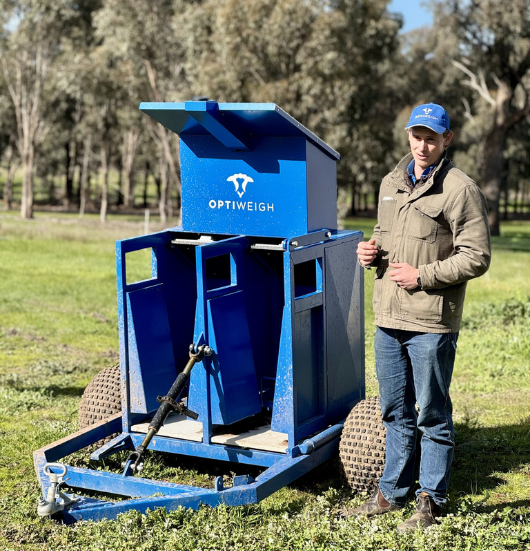
Support feed and containment decisions: Riverine Plains is trialling Optiweigh at Earlston Park near Violet Town to monitor liveweight changes and guide feed budgeting and groundcover management.
Knowing what your sheep weigh, and how that weight is changing, is one of the best guides to how your feed, flock and business are tracking. The catch has always been getting the numbers: mustering, yarding, running them over the crate, and the stress and weight loss that comes with it. In-paddock weighing systems get that information straight from the paddock, every day, without the yard work. At our Violet Town demonstration site we are using one of these systems, an Optiweigh unit, and the results so far have been very encouraging.
What is in-paddock weighing?
In-paddock (or walk-over) weighing systems are scales that stay out where the stock are, so sheep weigh themselves as they go about their day. Several systems are available in Australia and they work in slightly different ways. Some are platforms set up on a laneway or near a water point that sheep walk across, while others use an attractant such as a lick to draw sheep onto the scales.
Most share the same basic steps:
-
Sheep come to the scales. The unit is placed where sheep already go, or uses an attractant, so no training or mustering is needed.
-
The tag is read and the weight recorded. Each weight is linked to the animal’s eID tag, so you get individual as well as mob information.
-
The data comes to you. Many systems send data over mobile or satellite networks to an app or web portal, showing mob weight trends, average daily gain and individual weights.
Because these systems rely on eID tags, they fit neatly with the national move to sheep eID. Victorian flocks have been tagged since 2017, and in NSW all sheep will need an eID before leaving a property from 1 January 2027, so most producers will already have the tags they need.
How does it help farmers?
-
Less yarding, less stress, less weight loss. Every trip to the yards costs labour and can knock weight off sheep. One South Australian Merino producer using in-paddock scales saw lambs lose weight for 7–12 days after being yarded and re-mixed. In-paddock weighing avoids that.
-
See problems early. Daily data shows when weight gain starts to flatten, which can be the first sign that feed is running short, or of a health issue such as worms, before you would pick it up by eye.
-
Better feed decisions. Watching gains day by day shows whether a paddock, supplement or ration is doing its job, so you can adjust before it costs you.
-
Hit your targets. Track lambs towards sale weights and ewe lambs towards joining weights, and give your agent accurate weights ahead of sale.
-
Reliable numbers. For the system we’re using, comparisons with yard weights have found that in-paddock mob averages are within about 100 g of the auto-drafter weights. Daily liveweight gain figures become reliable after 2–4 weeks of data.
Ways you can use it
Portable units can be moved from mob to mob or left with one mob for a whole season. Producers use in-paddock scales to monitor weaners and finishing lambs, track replacement ewes towards joining weight, compare paddocks or pastures, check supplementary feeding, and plan turn-off. In containment they are especially useful: with sheep confined close to the scales, almost the whole mob can be weighed each day.
Things to consider when choosing a system
-
Cost: the upfront price plus any ongoing subscription or data fees.
-
Connectivity: how data gets from the paddock to you, and whether that works on your farm.
-
Portability: a fixed site, or a unit you can tow between mobs.
-
How it weighs: whole-body weighing, or front-feet weighing with a conversion to whole-body weight, and whether an attractant is needed.
-
Mob and paddock size: how many animals it can realistically weigh each day in your system.
-
Support: what help is available for setup, data and troubleshooting.
How we’re using it at Earlston Park
Our demonstration site at Don Piper’s property, Earlston Park near Violet Town, is testing which groundcover level (90%, 80% or 70%) should trigger moving sheep off paddocks and into Stock Containment Areas.
At the site we are using an Optiweigh unit, a portable, solar-powered system developed by NSW graziers Bill and Jacqui Mitchell. Sheep are drawn to the unit by an attractant such as a loose lick, molasses or salt. As they step up to feed, it reads their eID tag and weighs their front feet, and an algorithm converts that to whole-body liveweight. Data is sent every 1–5 hours over 4G, NB-IoT or satellite. A daily email arrives each morning summarising the last 24 hours, and the Optiweigh app and web portal show mob trends, daily gain and individual weights. The unit tows behind a ute or buggy and one person can set it up in a couple of minutes.
At Earlston Park, Optiweigh plays two roles:
-
Before containment, the unit rotates through the paddocks so the sheep get used to it and we can track liveweight trends as groundcover changes.
-
In containment, it tracks liveweight change to guide ration adjustments and feed budgeting, so sheep are fed to what they actually need.
Don’s experience so far
Don has been really pleased with Optiweigh. Being able to see how his sheep’s weight gain is changing every day means he can make adjustments early rather than waiting for the next time they come through the yards. It also gives him an early warning if something isn’t right: if a mob’s weights start to drop off unexpectedly, he knows to go and have a closer look at their health.
He has found the system simple to use, from moving the unit to checking the morning email and the app, and says the Optiweigh customer service has been excellent whenever questions have come up.
Tips from our experience with Optiweigh
-
Set the unit on firm, level ground, ideally near water or where sheep camp.
-
Zero the scales through the app each time you move the unit.
-
In containment pens, keep dirt and manure from building up under the platform, as it can affect readings.
-
Try a few attractants to find what your sheep like best; it makes a big difference to how many get weighed.
Want to know more?
If you’d like to learn more about in-paddock weighing or our containment demonstration, contact Sayra Samudio at Riverine Plains on sayra@riverineplains.org.au. For questions about Optiweigh, you can also contact Alexander Holt from the Optiweigh team directly at alex@optiweigh.com.au.
Riverine Plains is using Optiweigh as part of this demonstration but does not endorse any particular product. Other in-paddock weighing systems are available.
Acknowledgement
This project is supported by the Australian Government through funding from the Climate-Smart Agriculture Program under the Natural Heritage Trust.
Author
Sayra Samudio
Sustainable Practices & Farmer Engagement Manager Bachelor of Agricultural Engineering Master of Agricultural Sciences
1 November 2026
Share


NEWS
Keep up to date with what's happening across the Riverine Plains.
-
Grains