
Key messages
Nitrogen combined with manure can help achieve hyperyields in a good season.
Chemical fertiliser containing phosphorus (P), potassium (K) and sulfur (S) can achieve the same results as manure.
High rates of manure achieved the highest yields in a good season but were not economical.
Low rates of manure were economical in the long term but depend on the price.
Farmers and advisors should determine which nutrients are required that may be available in manure and consider using manure if it is a cheaper than chemical fertiliser.
BREAK CROP FERTILITY AND ORGANIC MANURES
Background & Aim
There is an abundance of organic amendment options in northeast Victoria, due to the proximity of feedlots and other intensive livestock operations. Consequently, there is local interest in using these by-products to supply nutrients for grain production systems and to improve any soil constraints.
Nitrogen fixation provides most of the nitrogen demand of grain legume crops at high yields (assuming adequate rhizobia function). A large part of this fixed nitrogen is exported in grain, which can affect the pulse crop’s potential to restore fertility to the soil and therefore may not be enough to sustain higher-yielding wheat and canola crops the following season.
This project was designed to evaluate whether the benefits of nitrogen fixation by legume crops can be amplified in a subsequent wheat and canola crop with added organic amendments as manure. It also looks at whether this can buffer the farm business from high synthetic fertiliser inputs.
Method
A faba bean crop was sown and harvested at Bundalong South, Victoria, in 2022. To leverage the fertility of this crop’s legacy, a manure trial was established the following year, with 16 treatments established on paired plots. The first treatments were established in early September 2022 when parts of the faba bean crop (which was at early to mid flower) were slashed and removed to create a ‘fallow’ effect while in other areas, the beans were slashed and spread evenly on the surface to create a ‘green manure’ effect.
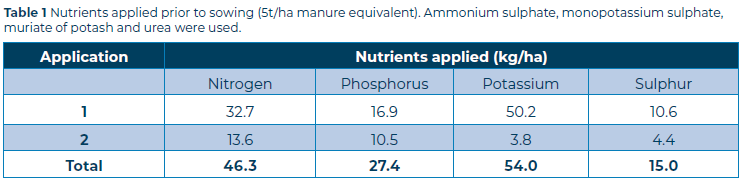
Prior to sowing wheat in April 2023, three rates of manure (2.5 t/ha, 5.0 t/ha and 10 t/ha, all at 23 percent moisture) were spread on the surface. Other treatments, including the nitrogen value of 5 t manure and the N-P-K-S value of 5 t manure, were spread prior to sowing (Table 1). A small amount was withheld while awaiting final test results for the manure and then applied on 1 June, 2023.
The whole trial was fertilised with the same rate of urea that the grower used on the surrounding paddock. Each pair of plots was split, with half of each treatment allocated an extra 75 kg/ ha of nitrogen. This amount was applied as top-dressed urea on 4 August at early stem elongation (GS32).
Results
Year 1 wheat, 2023
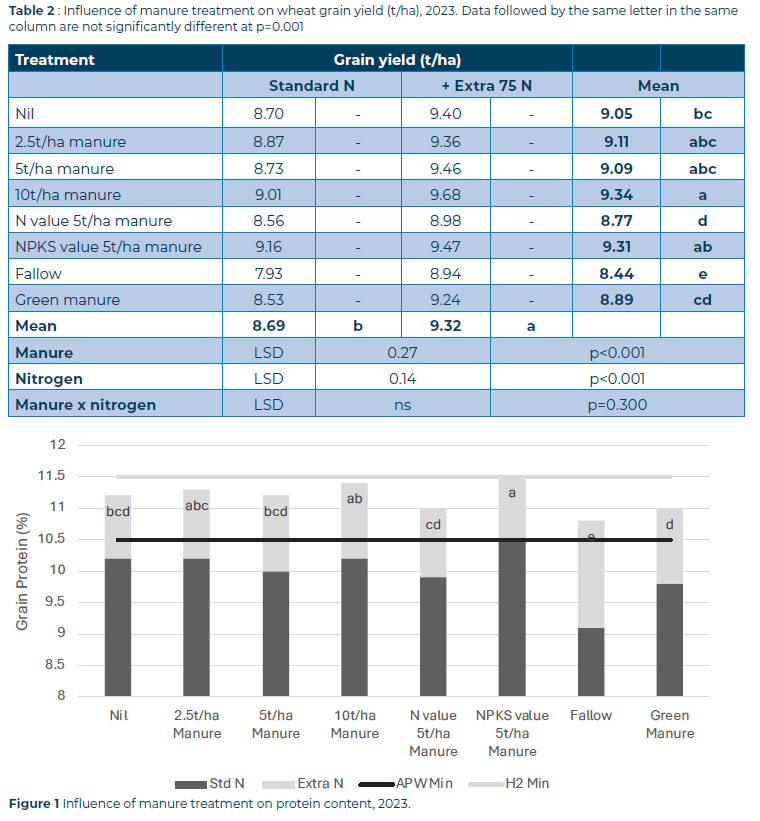
Grain yields averaged 9 t/ha across the trial (Table 2). The lowest yield recorded was 7.93 t/ha in the fallow treatment with no extra nitrogen, but while impressive, this yield demonstrates the benefits of additional fertility. Applying 10t/ ha of manure with an extra 75kg/ha of nitrogen was able to leverage an extra 1.75 t/ha of grain, producing the highest yield of 9.68 t/ha.
There was no interaction between manure treatment, nitrogen treatment and grain yield. However, supplying an additional 75kg/ha of nitrogen during the growing season increased yield by 0.63 t/ha, from 8.69 t/ha to 9.32 t/ha.
When yields were averaged across nitrogen treatments, use of a fallow was found to decrease grain yield by 0.61 t/ha, from 9.05 t/ha to 8.44 t/ha. Applying 10t/ha of manure increased grain yield by 0.29 t/ha to 9.34 t/ha. The NPKS 5 t/ha manure equivalent gave statistically the same yields as the 10t/ha of manure, however where only the nitrogen was applied (nitrogen value 5t/ha manure) the yield was lower than the control. Protein results are presented in Figure 1.
Year 2 canola, 2024
The objective of this trial was to assess the legacy of organic amendments and biologically fixed nitrogen strategies compared with inorganic based approaches. The trials details were as follows:
-
Location: Bundalong, Vic
-
Cultivar: PY525G
-
Sown: 5 April 2024
-
Harvested: 24 November 2024
-
Rotation position: wheat (2023), faba beans (2022), barley (2021), canola (2020) GSR: April–October 206.9mm
- Crop Nutrition: MAP – 30kg/ha spread pre-sowing and 60kg/ha incorporated at sowing (9 N total). Urea – Total of 400kg/ha spread over three applications (mid-May, mid-June and early July) (184 N total).
Harvest biomass
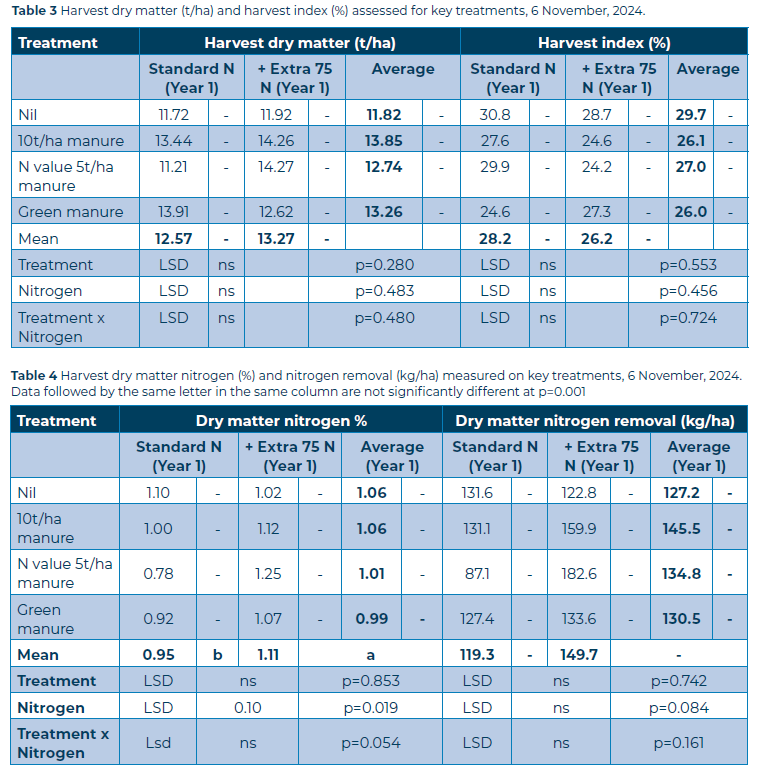
Dry matter (DM) cuts were taken on 6 November to measure the total biomass accumulated at maturity, with no differences detected between treatments (Table 3). Harvest index was calculated with an average figure of 27.2 percent, again with no differences detected between treatments.
Nitrogen content was measured in the harvest biomass (Table 4). The treatments where the extra nitrogen was applied had a slightly higher percentage of nitrogen (1.11% compared to 0.95%). When nitrogen uptake was calculated, there were no statistical differences in the total nitrogen (kg/ha).
Grain yield
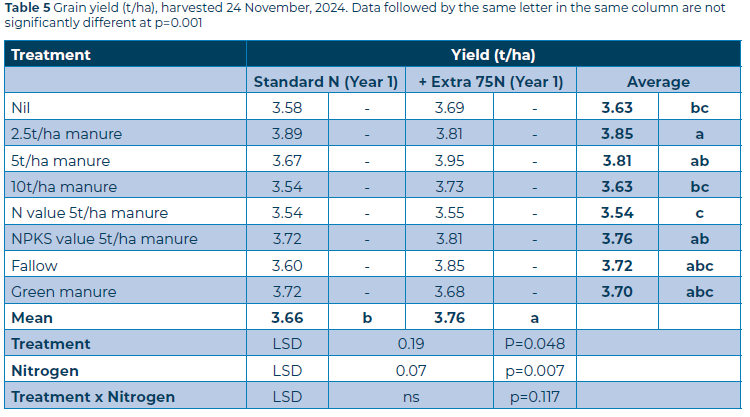
Plots were harvested with a plot harvester on 24 November (Table 5). There was no interaction between manure treatment and nitrogen treatment. Where the extra 75kg of nitrogen was applied in 2023, the yield increased by 100kg/ ha. The 2.5t/ha of manure treatment increased yield by 0.22t/ha compared to the nil treatment. Adding nitrogen fertiliser to the equivalent found in 5t/ha of manure decreased the yield by 0.9t/ha compared to the nil treatment, and although this was not significant, it was significantly lower than the 2.5t/ha and 5t/ha manure treatments and the NPKS treatment. All other treatments were statistically the same as the nil treatment. It could be surmised that when applying large amounts of nitrogen, additional nutrients (P, K, S) are needed to positively impact yield.
Year 3 Wheat 2025
The objective of this trial was to assess the legacy of organic amendments and biologically fixed nitrogen strategies compared with inorganic based approaches. The trials details were as follows:
-
Location: Bundalong, Vic
-
Cultivar: Matador
-
Sown: 7 May 2025
-
Harvested: 27 November 2025
-
Rotation position: Canola (2024) wheat (2023), faba beans (2022)
-
GSR: April–October 210.5mm
-
Crop Nutrition: • MAP – 40kg/ha spread pre-sowing and 60kg/ ha incorporated at sowing (10 N total) • Urea – Total of 300kg/ha spread over two applications (138 N total).
Grain yield
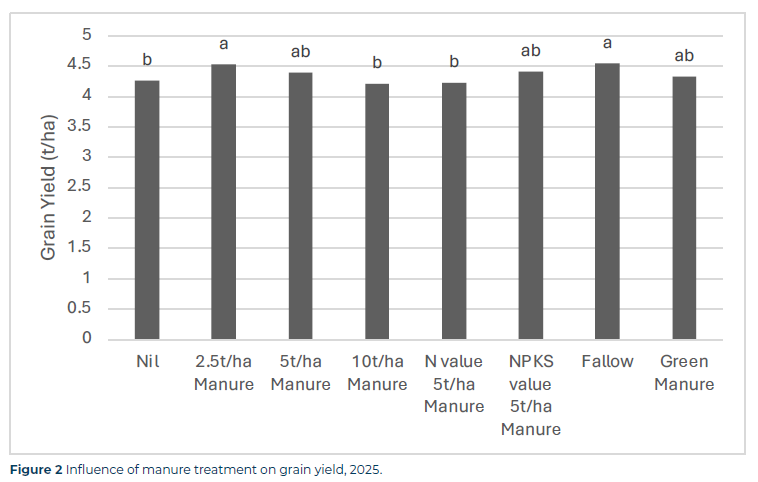
Plots were harvested with a plot harvester on 27 November. There was no interaction between manure treatment and nitrogen treatment. There was no difference in grain yield where the extra 75 kg/ha of nitrogen was applied in 2023.
The 2.5t/ha of manure treatment increased yield by 0.27t/ha compared to the nil treatment (Figure 2). The fallow treatment from 2022 also increased yield in 2025 by 0.28 t/ha. The other treatments were statistically the same as the control treatment. Statistical differences in grain quality were minor and had no effect on receival grade as all grain had high screenings (average 16.5%) and was classified as feed.
Conclusion
The wheat results from 2023 clearly demonstrate that nitrogen remained the dominant driver of yield in this high-yielding system, but that nitrogen efficiency was strongly influenced by nutrient balance. Only the highest manure rate (10t/ha) significantly increased yield when averaged across nitrogen treatments, and nitrogen-only strategies equivalent to manure performed poorly relative to balanced N-P-K-S nutrition. This confirms that organic amendments deliver benefits through a package of nutrients rather than nitrogen alone, and that imbalances can constrain yield and protein.
Interpretation of the 2024 canola and 2025 wheat results are less certain. Yield responses to manure and green-manure strategies were generally small and inconsistent, and while nitrogen applied in the previous season continued to influence yield in 2024, there was little clear evidence of a positive manure legacy effect. However, this should not automatically be interpreted as a simple ‘wearing down’ of manure-derived nutrients. It is equally plausible that canola is inherently less responsive to residual manure effects, particularly where nutrient release patterns do not align well with canola demand or where other constraints dominate yield formation.
The absence of strong biomass or nitrogenuptake differences in canola supports the view that manure legacy effects may be masked in this crop, rather than absent. As such, firm conclusions regarding manure persistence or decay cannot be drawn from the canola phase alone.
It is also plausible that the effects of the manure were not evident in 2025 due to the lower yield potential and it is possible that a legacy may appear in another high yielding season.
Economics
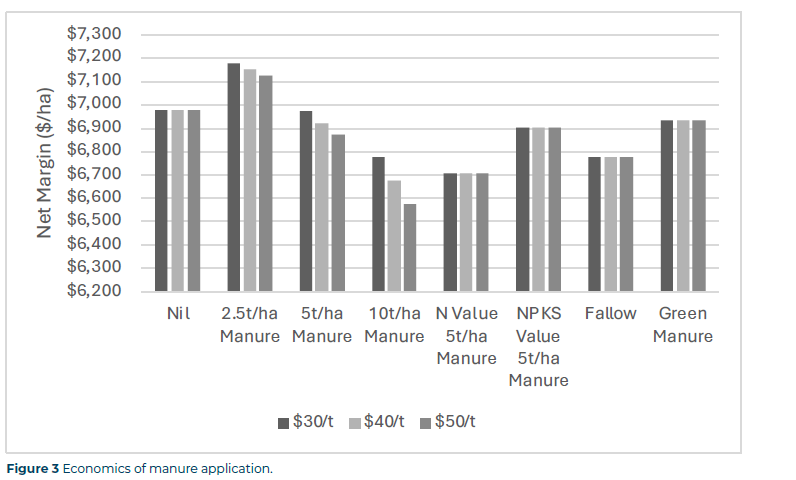
The total price of manure applied to a paddock is influenced by a range of factors. These include price at feedlot, distance from feedlot, spreading rate and whether the farmer uses their own equipment or engages a contractor. The variance in these factors, particularly the distance to feedlot, mean that a single benchmark price is unobtainable. For the economic calculations we have used three prices for manure; $30, $40 & $50 per tonne.
By adding up the grain value in each of the three seasons (2023-25) and subtracting the cost of manure (for the manure treatments) or fertiliser (for the fertiliser treatments), a net margin was calculated (Figure 3). Note that no value for lost production was afforded to the green manure and fallow treatments.
The 2.5 t/ha rate of manure was the most profitable treatment regardless of price. The 5 t/ ha manure rate was only competitive with the Nil treatment at the lowest manure price ($30/t). Other treatments lost money compared to the nil treatment.
Acknowledgements
The research undertaken as part of this project is made possible by the significant contributions of growers through both trial cooperation and the support of the GRDC, the authors would like to thank them for their continued support. This project is supported by GRDC through the National Grower Network (NGN) under GRDC project code: RPI2206-003SAX. Thanks go to the Inchbold family and their staff, as grower cooperators.
Authors
Ben Morris, Tom Price and Rebecca Murray, FAR Australia Ben Morris FAR Australia Shop 12, 95–103 Melbourne Street, Mulwala NSW 2647 0400 318 334 ben.morris@faraustralia.com.au
Author
1 July 2026