
Key messages
Our comparison of several forecasting apps showed BoM’s range midpoints and Jane’s Weather single-number forecast aligned most closely with actual rainfall received at Riverine Plains weather stations, with Weatherzone (Elders) also useful for its narrow ranges and decent accuracy.
YR presents a forecast from a single model, so is best used as a quick cross check alongside other apps to reduce the risk of forecasts bouncing around.
Alignment with local gauges drops off the further out the forecast period is, so forecasts beyond a few days are best used as a heads-up for planning.
Heavy rain is hardest for every app to predict, because storms can deliver 10–60 mm differences over short distances.
No single app is perfect: the best strategy is to check for consensus across apps and confirm with local gauges and radar before making key operational decisions.
RAINFALL FORECAST ALIGNMENT WITH RIVERINE PLAINS’ WEATHER STATION DATA
Background
Rainfall drives many high-cost decisions in broadacre and mixed farming systems. Seasonal outlooks help set an overall season plan, but dayto- day calls such as spraying, urea applications, sowing depth, irrigation timing and harvest logistics depend on short-term rainfall forecasts. Because different apps use different models and present rainfall in different ways, growers can benefit from knowing which apps tend to line up best with what’s measured at local gauges.
Aim
To compare how closely four rainfall forecast apps — Bureau of Meteorology (BoM), YR, Jane’s Weather, and Weatherzone (Elders) — aligned with rainfall recorded across the Riverine Plains weather station network, to support day-to-day farming decisions.
What we did
We compared nearly two months of daily rainfall forecasts from 17 July to 14 September, 2025, against observed rainfall from five Riverine Plains weather stations at Miepoll, Rutherglen, Burramine, Urana, and Culcairn. Due to technical issues, Miepoll station data were only included up until late August.
Apps present rainfall forecasts differently. While YR provides a daily rainfall forecast value (i.e. 5 mm), BoM and Weatherzone provide a forecast range (i.e. 5–10 mm), with Jane’s Weather providing both a single value and a range. To compare apps on the same basis, range forecasts were converted to a single value using the midpoint of the predicted range (i.e if the range was 5–10 mm, the midpoint would be 7.5 mm), then compared with the recorded weather station rainfall total.
Results are reported by Lead Day, which is how many days ahead the forecast was issued. Lead Day 1 is the forecast for the next day, while Lead Day 10 refers to the forecast for 10 days’ time. Performance was summarised using mean absolute error (MAE), which is the average difference in mm between the forecast rainfall and what the local gauge recorded. We calculated MAE for each Lead Day, with a separate analysis for heavy rain days where the station recorded more than 10 mm.
We also assessed range quality using “range reliability”, which is the percentage of days where the recorded station rainfall fell within the app’s forecast range. Average width is the size of the forecast range in mm. These metrics were used to assess the trade-off between range reliability and precision (narrower ranges).
Lead days 1 to 6: daily rainfall forecast performance
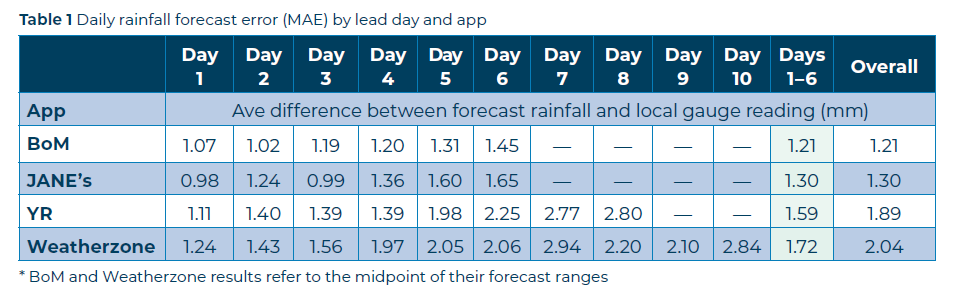
BoM performed best overall when assessed by its range midpoint, with a midpoint error of about 1.21 mm (Table 1), often being very close to the actual rainfall received at a site from Day 1 up to Day 6 of the forecast.
Jane’s Weather was second best overall, with an average difference of about 1.30 mm from the local station rainfall and was the top performer on some individual lead days (for example, Lead Day 1 and Lead Day 3).
YR was straightforward to read, but its average difference from station rainfall was larger at about 1.59 mm, and it tended to drift further from station totals as lead time increased.
Weatherzone provided clear ranges, but when assessed by its range midpoint it had the largest average difference from station rainfall in this comparison, about 1.72 mm. Rainfall totals were low during the period of analysis, which is reflected in the small differences seen in Table 1.
Heavy rain days over 10 mm
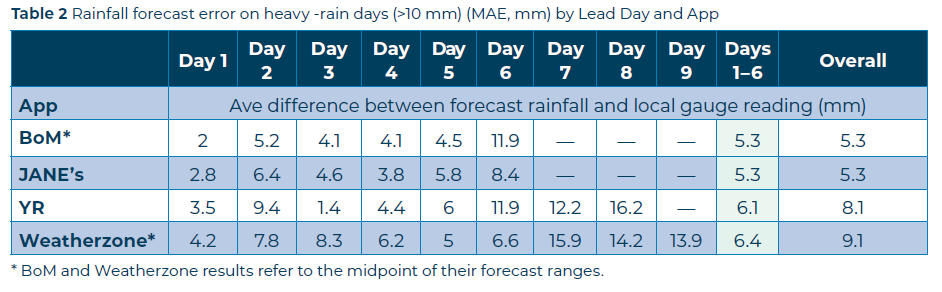
On heavy rain days where the station recorded more than 10 mm, every app aligned less closely with local station totals. BoM’s range midpoint and Jane’s Weather single-number were closest to actual totals in the shorter lead window, while YR and Weatherzone’s range midpoint were generally less aligned the longer the lead time.
For Lead Days 1 to 6, the average differences were 5.3 mm for both BoM and Jane’s Weather (Table 2), compared with 6.1 mm for YR and 6.4 mm for Weatherzone. As lead time increased, heavy rain forecasts became less dependable for all apps. From Lead Day 6 onwards, differences blew out beyond 10 mm, with fewer heavy rain events to compare.
Rainfall ranges: range reliability vs width (forecast range)
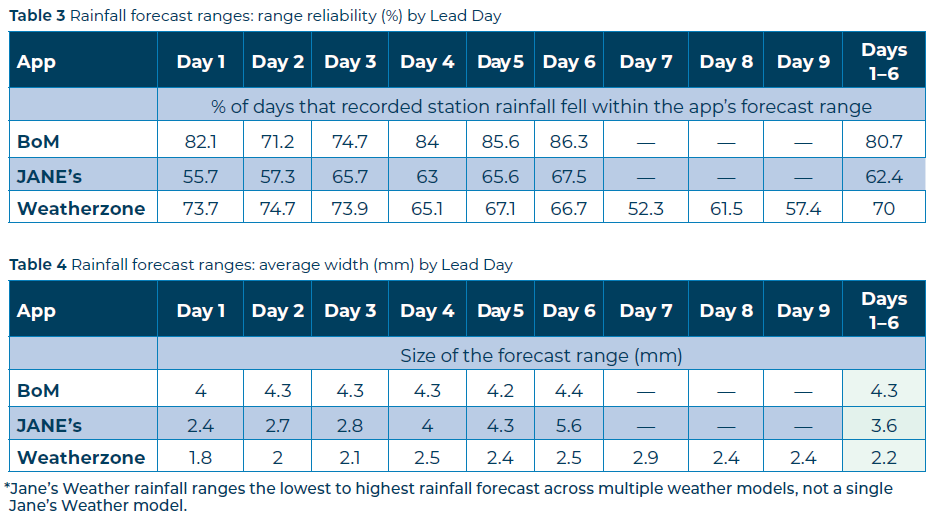
Weatherzone generally presented narrower ranges and still achieved reasonable range reliability. However the midpoint of the range aligned less closely with station rainfall, so its overall error result was higher (Table 3).
BoM had the highest range reliability, but it achieved this with the widest ranges (Table 4), which is a more conservative style that provides less specific forecasts for decision-making.
Jane’s Weather provided narrower forecast ranges than BoM, based on the spread of multiple models on its platform. In this analysis, the narrower ranges resulted in more misses, with actual rainfall falling outside the forecast range more frequently.
Single model forecast vs blended forecast apps
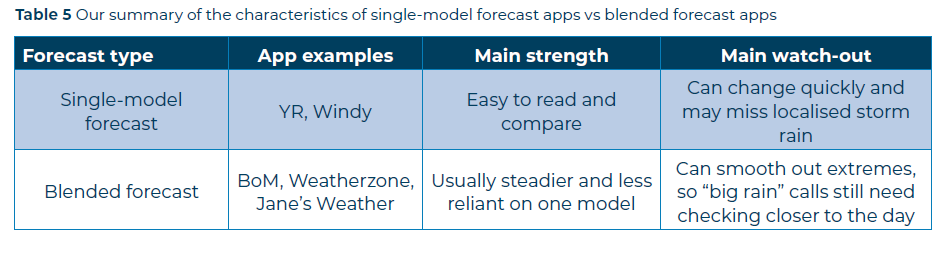
Some apps, such as YR and Windy, show rainfall as one number pulled from a single computer model. It’s easy to read, but it is only that model’s best estimate for one grid point, and it can change a lot between updates, especially when looking several days ahead. These apps can also miss localised storm rain because falls can be patchy and smaller than the model grid, so the main rain band may land 5 to 50 km away (Table 5).
Other apps, such as BoM, Weatherzone, and Jane’s Weather, show rainfall as a range, or as a single number with a range in brackets. This is usually based on a blend of models plus shortterm meteorologist oversight. The range helps show how much the weather models agree. A wide range usually means a hit-and-miss rainfall event, like showers or storms, while a narrower range more often points to a more even system, such as from a front. Blending can smooth out extremes when models disagree, so treat “big rain” calls as an early heads-up until closer to the day, then confirm with radar and nearby gauges.
Conclusions
Over this comparison period, BoM’s rainfall range midpoint and Jane’s Weather single-number forecasts most often lined up the best with Riverine Plains station rainfall, making it slightly more useful for day-to-day planning (noting that differences were small due to low total rainfall received during this period).
All apps aligned less closely the further ahead the forecast period. On days when gauges recorded more than 10 mm, every app forecast was less aligned with the station totals, reflecting the reality that storm rain is patchy and can vary by 10 to 60 mm over short distances.
We found that YR and Weatherzone (Elders) are most useful as cross-checks, instead of on their own. YR reflects a single model output and is popular because it provides an “exact” rainfall number for specific postcodes up to 10 days ahead. Weatherzone adds value through its narrow rainfall ranges which deliver reasonable range reliability.
Overall, the best approach is to look for a consistent story across multiple apps, confirm it against local gauges and radar, and use seasonal forecasts to manage risk and probabilities, rather than to seek absolute certainty.
Acknowledgements
This project is supported by Victoria Drought Resilience Adoption & Innovation Hub (Vic Hub) investment, through funding from the Australian Government’s Future Drought Fund. Riverine Plains is the Vic Hub’s North East Node lead.
Special thanks to the farmer co-operators of the Riverine Plains weather station network for providing the ground-truthed data.
Full Project Title: SCOUT: Weather Forecast Accuracy Validation
Author
Peter Chen
Master of Agricultural Science, The University of Melbourne, Bachelor of Agronomy, National Chiayi University
26 June 2026