
Key messages
Match nitrogen inputs to realistic yield potential, not best-case hopes.
Be targeted, not uniform. Whether it is better paddocks or better zones through variable rate equipment. Think about where you will get the most return.
- Always bring decisions back to economic yield, not just production potential.
Making every kilogram count
With nitrogen (N) fertiliser one of the biggest variable costs in grain production, growers in southern New South Wales and north-east Victoria will be looking to optimise their fertiliser use and spend this season (with what will be available). Current guidance from the Grains Research and Development Corporation (GRDC) research points matching N supply to realistic yield potential, existing soil N, and crop demand.
A practical first step is to tighten the N budget paddock by paddock. That means accounting for mineral N already in the profile, likely mineralisation, previous legume crops or manure history, and stored soil moisture before deciding on rate. GRDC guidance for southern systems notes that delayed or split applications can be a sound strategy where seasonal uncertainty is high, because growers can wait until yield potential is clearer before committing the full spend. For wheat, a useful rule of thumb is around 40 kilograms of N per hectare for each tonne of grain yield target; canola has a substantially higher demand, with GRDC material indicating about 75–80 kilograms of N per hectare per tonne of yield potential.
For wheat and barley, one of the best opportunities to save money this year may be avoiding blanket rates across whole paddocks. Historic grain protein maps, yield maps, and targeted deep N tests can help identify where crops were and may be genuinely N short and where they were/will be adequately supplied. If maps are not available, historic Normalised Difference Vegetation Index (NDVI) images are also a good reference and deep N tests will be vital.
What are we aiming for?
GRDC Update work shows wheat grain protein below about 11.5 per cent generally indicates that N supply was insufficient to meet water-limited yield potential, making protein mapping a useful guide for refining future N investment. In other words, some paddock zones may justify a top-up, while others may not return the extra urea. This year, ‘optimum’ goal posts may shift so keep this in mind and be selective.
Timing also matters. Don’t leave this behind in all the noise. If you have access to urea, make sure it goes on at optimum timing, and if possible, ahead of a ‘high chance’ rain event to minimise volatilisation losses.
In canola especially, the aim should be to protect early vigour and yield potential without overcommitting too early. Canola is a high N-demand crop, but its profitability still depends on matching total fertiliser to seasonal conditions and stored soil moisture.
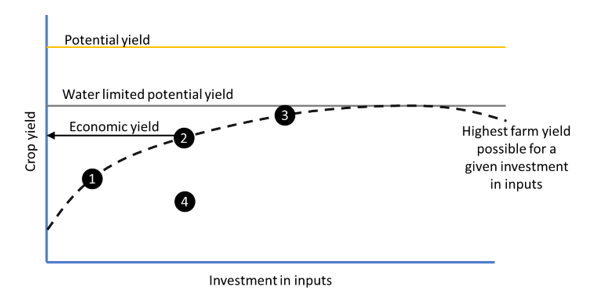
A useful budgeting and decision tool is Yield Prophet Lite. It can be used to test likely crop performance under different soil moisture and nitrogen (N) scenarios. By combining local rainfall, soil N and planned N inputs, the tool can help estimate a realistic yield range. Keep in mind this is production yield not economic yield. All decisions should be related back to whether the dollars stack up. See Figure 1.
Summary
With fertiliser supply likely to be tighter and prices higher this season, nitrogen (N) decisions will be under greater scrutiny. For growers in southern New South Wales and north-east Victoria, the focus will need to be on using available urea where it is most likely to deliver a yield return, rather than applying standard rates by default. That means grounding decisions in realistic yield potential, existing soil nitrogen, stored soil moisture, and seasonal conditions.
A more targeted approach to timing and rate can help reduce risk and improve efficiency. Tools such as deep soil nitrogen testing, historic paddock performance data, grain protein maps, and NDVI imagery can support more informed decisions about where nitrogen is likely to pay and where it may not. The strongest nitrogen strategy will be one that is selective, timely, and economically grounded.
Further resources & decision support
GRDC Nitrogen fertiliser management in 2022
GRDC Update paper: Busting the big yield constraints where to next
GRDC fertiliser decisions ahead of planting
Smart Fertilisers: Deep soil testing: Critical for nitrogen decision-making in 2026
Let us know if you are interested in joining an online discussion to support implementation of variable rate application. Get in touch.
Author
Lynn Macaulay
Member Engagement Officer Bachelor of Agriculture and Farm Business Management
30 March 2026
Share


.svg)
